

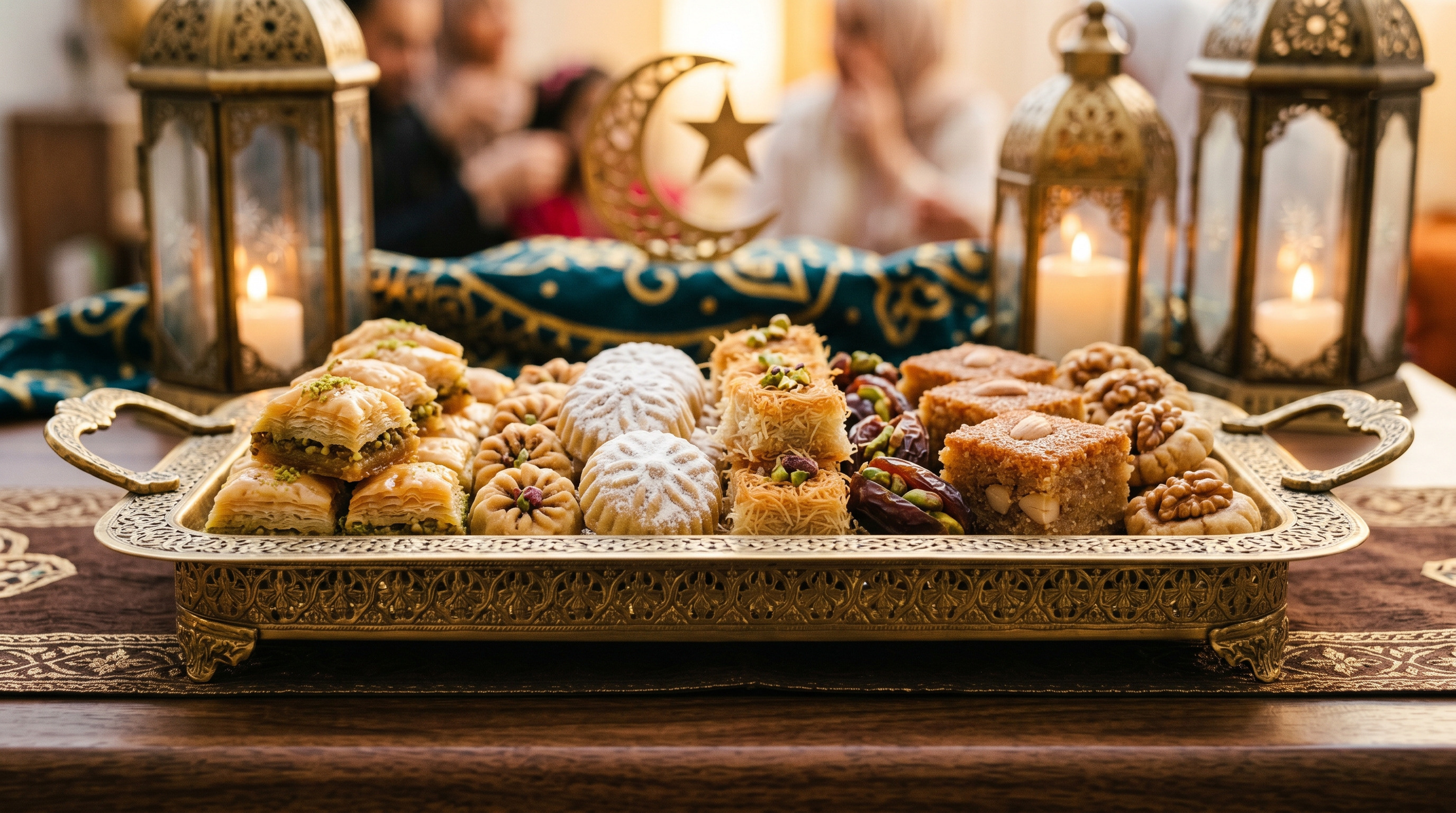
Eid tables around the world end the same way — something sweet, something made with love. These five desserts come from Turkey, Morocco, and beyond. All can be prepped a day ahead. None will disappoint.
1. Güllaç — Turkey’s Eid Classic
Turkey’s most beloved Eid dessert. Delicate rice wafer sheets soaked overnight in rose-scented warm milk, layered with pomegranate and walnuts. Light, floral, and quietly spectacular.
Prep: 20 mins | Chill: Overnight | Serves: 6

Ingredients
- 10–12 güllaç sheets (rice paper)
- 1 litre of full-fat milk
- 4 tbsp sugar
- 2 tbsp rose essence
- Seeds of 1 pomegranate
- ½ cup walnuts, roughly chopped
- A few mint leaves to garnish
Method
- Pour milk into a saucepan.
- Add sugar. Heat on low until sugar dissolves.
- Remove from heat. Add rose water. Stir gently.
- Let the milk cool until warm to the touch.
- Dip one güllaç sheet into the warm milk.
- Let it soften for 10–15 seconds.
- Lay it flat in a deep tray.
- Scatter a handful of walnuts and pomegranate seeds on top.
- Dip the next sheet. Layer it on top.
- Repeat until all sheets are used.
- Pour the remaining rose milk evenly over the top.
- Cover and refrigerate overnight.
- Before serving, scatter pomegranate seeds and walnuts on top.
- Add a few mint leaves. Slice and serve cold.
2. Chebakia— Morocco’s Honey Cookie
Morocco’s Eid staple. Sesame and flour dough shaped into flowers, fried golden, then dunked straight into warm honey. Crunchy, sticky, aromatic, and completely addictive.
Prep: 40 mins | Cook: 30 mins | Makes: 25–30 pieces

Ingredients
- 2 cups all-purpose flour
- ½ cup sesame seeds, toasted
- ½ tsp cinnamon powder
- ½ tsp anise powder
(Grind approximately 1/2 star anise to get ½ tsp powder) - ½ tsp finely grated orange zest
- 1 tsp rose essence water
- 2 tbsp white vinegar
- 2 tbsp oil
- Warm water as needed
- Oil for deep frying
- 1½ cups of honey for coating
- Extra sesame seeds for finishing
Method
- Mix flour, toasted sesame, cinnamon, and anise in a bowl.
- Add orange zest + rose water, vinegar, and oil.
- Mix well.
- Add warm water little by little.
- Knead into a smooth, firm dough.
- Divide into small balls.
- Roll each ball thin on a lightly floured surface.
- Cut into rectangles about 8×5 cm.
- Make 4 small slits lengthwise in each rectangle.
- Fold and weave the dough through the slits to form a flower shape.
- Pinch the ends to hold the shape.
- Heat oil in a deep pan on medium heat.
- Fry in batches until deep golden. About 3–4 minutes per batch.
- Remove and drain on paper.
- Heat the honey in a separate pan until warm and runny.
- Drop fried chebakia straight into the warm honey.
- Let them soak for 1–2 minutes.
- Remove and place on a tray.
- Sprinkle sesame seeds on top while still sticky.
- Cool completely before storing. They keep well for up to 2 weeks.
3. Sellou — Morocco’s No-Bake Sweet
No oven. No stove. Just toasted flour, sesame, almonds, honey, and butter mixed into something that tastes like it took hours. A Moroccan Eid classic that lasts for weeks and gets better every day.
Prep: 30 mins | Cook: 15 mins | Serves: 8–10

Ingredients
- 2 cups all-purpose flour
- 1 cup sesame seeds
- 1 cup almonds, blanched
- ½ cup honey
- ½ cup unsalted butter, melted
- 1 tsp cinnamon powder
- ½ tsp anise powder
(Grind approximately 1/2 star anise to get ½ tsp powder) - A pinch of salt
- Icing sugar to dust on top
Method
- Toast flour in a dry pan on low heat.
- Stir continuously until it turns lightly golden and smells nutty. About 10–12 minutes.
- Remove and let it cool completely.
- In the same pan, toast sesame seeds until golden. Set aside to cool.
- Roast almonds in the pan until lightly golden. Set aside to cool.
- Grind toasted sesame seeds to a coarse powder.
- Grind roasted almonds to a coarse powder separately.
- In a large bowl, combine toasted flour, sesame powder, and almond powder.
- Add cinnamon, anise, and a pinch of salt. Mix well.
- Pour in melted butter. Mix until evenly combined.
- Add honey. Mix again until the mixture holds together.
- Taste. Add more honey if needed.
- Press into a serving dish or shape into balls.
- Dust generously with icing sugar on top.
- Refrigerate for at least 2 hours before serving.
- Keeps well in an airtight container for up to 3 weeks.
4. Khubani ka Meetha — Hyderabad’s Eid Gem
Hyderabad’s most iconic Eid dessert. Slow-cooked dried apricots that melt into a deep, tangy, amber-coloured pudding, served cold with a generous pour of fresh cream or custard. One spoonful and you’ll understand why every Hyderabadi table ends with this.
Prep: 10 mins + overnight soaking | Cook: 25 mins (40 mins if making custard) | Serves: 4

Ingredients:
- Around 30 khubani or dried apricots
- 2 cups of water
- 3 tsp sugar (slightly more or less, depending on the sweetness of the dried apricots
- 1 tsp lemon juice
- Sliced almonds
For Custard
- 1-litre full-fat milk
- ½ cup vanilla custard powder
- 1 cup sugar
Method:
- Making the recipe commences a night prior; soak the dried apricots in about 2 cups of clean drinking water. The next morning, the dried apricots would have absorbed water and swollen up.
- Remove the apricots but retain the water it was soaked in. Chop the apricots or mash them lightly to extract the seed. Lightly mash the fruity part of the apricots. The seeds contain small variants of almonds in them; crack open the seeds to extract the nut. Keep the nuts aside for use later.
- In a kadhai or saucepan, keep the flame low to medium, add the chopped apricots and lightly mash them. Due to the soaking, they become very soft and mash easily. Add the sugar and stir it well. Cook the mixture until the apricots mash and get a jam-like texture. You can add a few drops of lemon juice just to balance out the flavours. Cook for another minute and turn off the flame.
- Preparing the custard is very easy. Preferably use the vanilla variant, as that complements the khubani flavours very well.
- Boil the full-fat milk until it thickens and reduces in size. Now, remove a cup of milk, add sugar to the remaining milk and boil some more.
- In the cup of milk, add the custard powder and dissolve it well. Make sure no lumps remain in the mixture.
- Very slowly add the custard mixture to the remaining milk, and cook it for a few minutes until the mixture thickens.
- Remove from the flame and allow it to cool. Once cooled, you can refrigerate it to get a thick and creamy vanilla custard.
- This step can be done the previous night, so the next day you have chilled custard ready.
- To serve, preferably take a glass or see-through servingware to show the layers of the dessert. Spread a thick layer of the custard at the base. Top it with a layer of the khubani ka meetha.
- Garnish it with the nuts extracted from the kernels of the apricot. Enjoy!
5. Basbousa — Arabic Semolina Cake
One bowl, one tray, one hour — and you have a dessert that feeds a crowd. This semolina cake from the Middle East soaks up a rose water sugar syrup until every bite is dense, moist, and fragrant. An Eid favourite from Egypt to the Gulf.
Prep: 15 mins | Cook: 25 mins | Serves: 10–12

Ingredients:
- 2 cups semolina
- ½ cup ghee
- 1 tbsp honey
- ½ cup sugar
- ½ plain thick yoghurt
- ½ tbsp baking powder
- ½ cup grated dried coconut (optional)
- ½ tsp tahini
For Syrup
- 1 cup sugar
- 1 cup water
- 1 tsp lemon juice
- 2 tbsp honey
- ½ tsp vanilla extract
- Mixed nuts for garnishing
Method:
- Preheat the oven to 300°C. Take a large bowl and add the semolina to it. Now add the dry ingredients like baking powder, dried grated coconut, and sugar and mix everything well.
- Now, in another pot, melt some ghee. Once melted, add the honey to it and stir well.
- Add the ghee and honey combination to the dry ingredients and mix them well, taking care to avoid clumps.
- Next, add the yoghurt and fold it in until everything is well blended and the batter is smooth.
- Take a cake tin and grease it well. Next, add a layer of mixed nuts at the base of the tin. Now transfer the basbousa batter to it. Transfer the baking tin to the oven. Bake for about 10 minutes or until the edges become lightly golden.
- While the basbousa is baking, begin the preparations for the syrup. Take a medium-sized saucepan and add all the ingredients of the syrup in it. Maintain the flame on medium and bring the contents to a boil.
- Once the syrup begins to boil, reduce the flame and allow it to simmer for about 10 minutes or so.
- Once the basbousa is done, remove it from the oven and the tin. Pour the syrup all over the basbousa evenly and generously.
- Once the syrup is poured, immediately cover the basbousa with foil, and place it back in the oven (which is turned off but still warm) for the syrup to infuse well.
- After about 10 minutes, remove from the foil, cut into pieces and enjoy.
Made one of these? Tell us which one in the comments. Share this with someone who’s got a sweet tooth this Eid. 👇
You may also like:
No saffron Mathai in Eid festival
Nice