

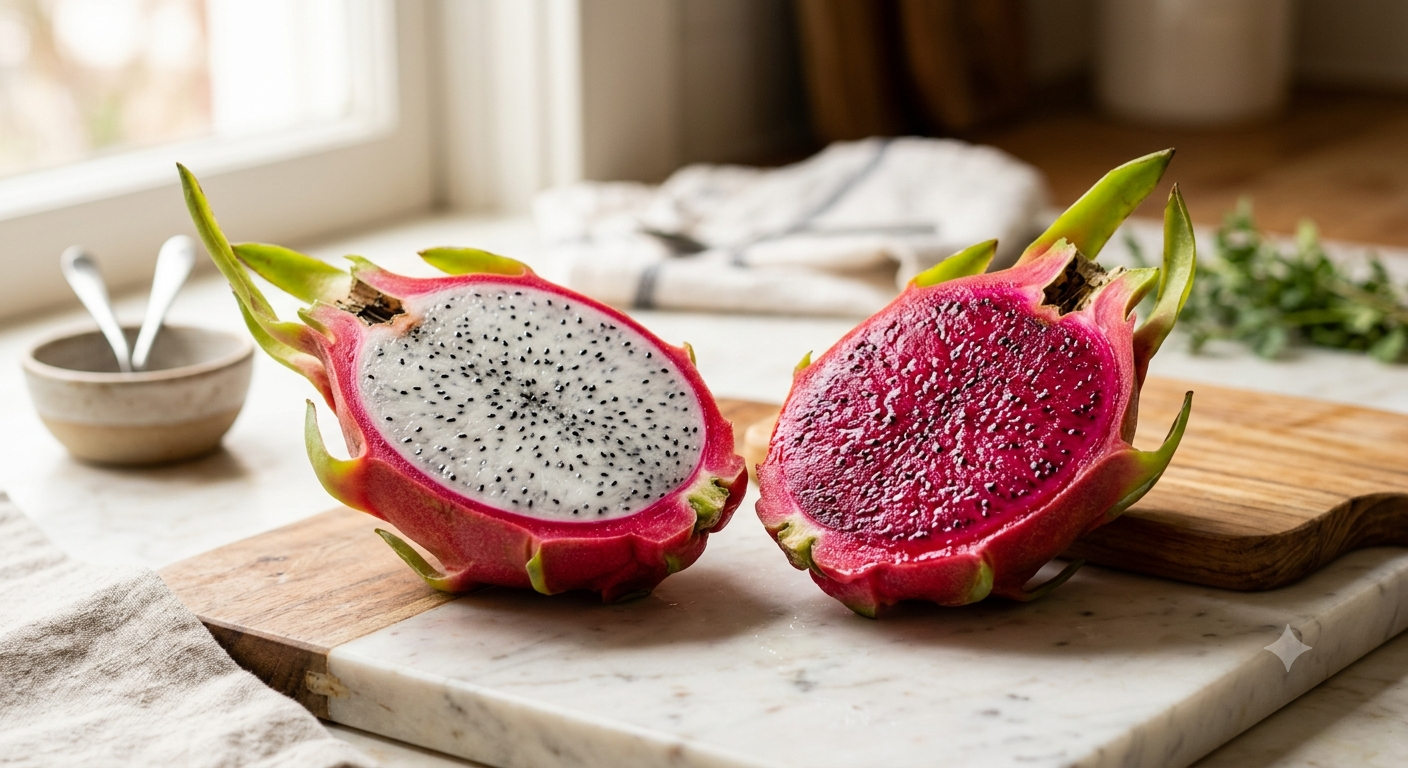
You’re in the fruit aisle, holding two dragon fruits. Same pinkish-red skin, same green-tipped scales, same look of a fruit designed by a cartoonist. Yet one is white inside, the other is a deep red, and the skin gives nothing away.
If you tried dragon fruit once at a wedding buffet and never worked out what you actually ate, you’re not alone. This guide walks you through the types of dragon fruit, how each one tastes, the dragon fruit benefits worth knowing, and the easiest ways to eat them.
Same Skin, Different Dragon Fruit
Three things set them apart: skin colour, flesh colour and taste.
The skin is usually a pinkish red, though one variety is yellow. The flesh is where the real surprise is. It can be white, pink, red or deep purple, always dotted with tiny black seeds that you can eat.
These are the dragon fruit varieties you’re most likely to hear about:
- White flesh, red skin: the mild, everyday white dragon fruit
- Red flesh, red skin: the sweeter, juicier red dragon fruit
- Pink flesh, red skin: sits between white and red in colour and taste
- Purple flesh, red skin: the darkest and boldest of the lot
- White flesh, yellow skin: smaller, and often the sweetest
Taste varies by variety. Among the red-skinned ones, red and purple flesh are generally sweeter and juicier than white.
White Flesh Dragon Fruit (Red Skin)

This is the one most of us meet first. Red outside, snow-white inside and speckled with black seeds, it looks a bit like a kiwi in black and white.
The taste is mild, lightly sweet and refreshing, somewhere between a pear and a kiwi without the tang. The texture is soft and juicy, and the seeds add a gentle crunch.
It suits you if you don’t enjoy very sweet fruit, or if you’re serving children and elders who like gentle flavours.
White flesh is best eaten chilled. Halve it and scoop with a spoon, or cube it into a fruit chaat with a squeeze of lime and a pinch of chaat masala. Because it’s mild, it pairs well with bolder fruits like pineapple and pomegranate. Shop white flesh dragon fruit for your next breakfast bowl.
Red Flesh Dragon Fruit (Red Skin)

Cut this one open and someone at the table will say “wow”. The flesh is a deep red-magenta, a colour you’d expect from beetroot rather than a fruit.
It’s sweeter and juicier than the white variety, with a slightly berry-like taste. The soft flesh is dotted with tiny edible seeds.
That colour comes from betalains, natural pigments also found in beetroot. Betalains are antioxidants, which is why red flesh carries more antioxidant pigments than white.
Red flesh shines wherever you want colour without food colouring: smoothies, juices, lassi and smoothie bowls. A few cubes will turn plain curd or a milkshake bright pink. Blend it with banana and chilled milk for an easy start. Pick up a red flesh dragon fruit for your weekend smoothie.
One fair warning: it stains. Hands, chopping boards and white kurtas are all at risk, so cut it on a plate, wash up soon after, and save the white clothes for another day.
Pink, Purple and Yellow Varieties

Pink flesh, red skin. This one sits between white and red in both colour and taste. The inside is a soft pink and the sweetness is moderate.
Purple flesh, red skin. Darker than red, with a bolder sweetness and an intense colour. Like red, it has more betalain pigments, and it stains just as cheerfully.
White flesh, yellow skin. Smaller, with yellow skin and white flesh dotted with larger, crunchier seeds. It is often described as sweeter and more fragrant than many red-skinned varieties.
These are good to know about, but for everyday eating, white and red remain the two easy choices.
Dragon Fruit Benefits by Type
Every dragon fruit is low in calories, hydrating, and contains fibre, vitamin C and antioxidants. Each type also has something it does best.
- White flesh, red skin: A good source of fibre from both flesh and seeds, with a low calorie count and a refreshing, subtle taste. It’s the lightest everyday choice.
- Red flesh, red skin: More betalain pigments than white, along with a sweeter, juicier bite.
- Pink flesh, red skin: Contains vitamin C, and its gentle sweetness makes it an easy fruit to eat often.
- Purple flesh, red skin: The most betalains of the lot. These antioxidant pigments are what give it that deep colour.
- White flesh, yellow skin: Usually the sweetest of the group, so it works as a dessert all by itself.
The fibre may support digestion and helps you feel full for longer. Still, it’s a fruit, not a medicine, so enjoy it as one part of a balanced, varied diet.
How to Pick, Cut and Store Dragon Fruit
To pick
- Look for bright, evenly coloured skin. A few marks are fine, but many dark blotches mean it’s past its best.
- Press gently. A ripe fruit gives a little, like a ripe mango.
- Check the leafy tips. Slightly dry is normal, but brown and brittle means it has been sitting around.
To cut
- Wash the fruit and slice it in half lengthwise.
- Scoop out the flesh with a spoon, or cut it into quarters and peel the skin back.
- Cube or slice it. The seeds are edible, the skin is not.
To store
- Keep a ripe, uncut fruit in the fridge and eat it within a few days.
- Leave a firm one on the counter for a day or two to soften.
- Store cut fruit in an airtight box in the fridge and finish it within a day.
So the next time two identical dragon fruits stare back at you, you’ll know what to expect. Go white for something mild and refreshing, red for something sweeter and more colourful.
Better still, explore the dragon fruit range, bring home one of each and let your family vote.
You may also like:
0 comments on “Know Your Dragon Fruit: Types, Colours, Taste and Benefits”