

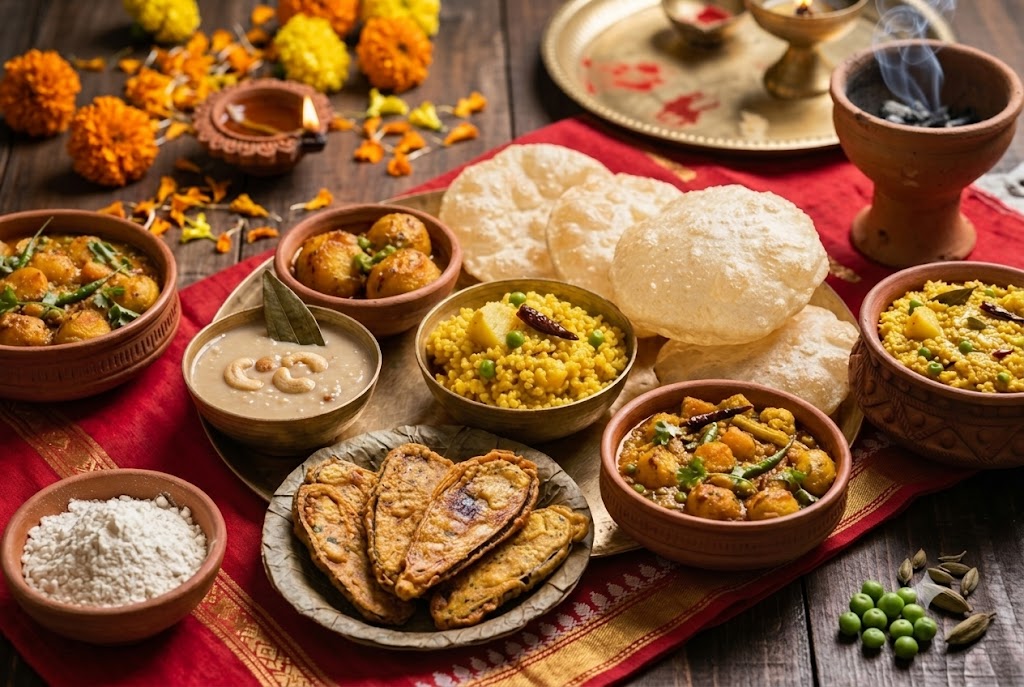
Vijayadashami, or Dashami, marks the final day of Durga Puja in Bengal, when Goddess Durga bids farewell before her immersion. As the celebrations wind down, families come together for Bijoya, exchanging greetings, sweets and warm wishes.
Food is central to these gatherings, with festive favourites varying from household to household. From luchi and alur dom to ghugni, payesh, and homemade sweets, these beloved Bengali dishes bring Bijoya’s warmth and nostalgia to the table.
1. Bhoger Khichuri

A quintessential Bengali Puja favourite, Bhoger Khichuri brings together roasted moong dal, fragrant Gobindobhog rice, seasonal vegetables and whole spices. Traditionally prepared without onion and garlic, this comforting one-pot dish is closely associated with Durga Puja bhog and festive community meals.
Prep time: 15 mins | Cook time: 35 mins | Servings: 4
Ingredients
- 1 cup Gobindobhog rice
- ¾ cup yellow moong dal
- 1 medium potato, cubed
- 1 cup cauliflower florets
- ½ cup green peas
- 1 medium tomato, chopped
- 1 tbsp grated ginger
- 2 green chillies, slit
- ½ tsp turmeric powder
- 1 tsp cumin seeds
- 2 bay leaves
- 1-inch cinnamon stick
- 3 green cardamoms
- 3 cloves
- 1 tsp cumin powder
- ½ tsp garam masala
- 2 tbsp ghee
- 1½ tsp salt, or to taste
- ½ tsp sugar
- 5 cups hot water
Method
- Dry-roast the moong dal in a pan over medium heat until lightly golden and aromatic. Set aside.
- Wash the Gobindobhog rice gently and drain well.
- Heat ghee in a heavy-bottomed pan. Add bay leaves, cumin seeds, cinnamon, cardamom and cloves.
- Once fragrant, add ginger and green chillies. Sauté for 30 seconds.
- Add potato, cauliflower, peas and tomato. Add turmeric, cumin powder and salt. Cook for 3–4 minutes.
- Add the roasted dal and rice and mix gently.
- Pour in 5 cups of hot water and bring to a boil.
- Cover and cook on medium-low heat until the rice, dal and vegetables are soft and creamy.
- Add sugar and garam masala towards the end.
- Finish with 1 tsp ghee and serve hot.
2. Labra

A rustic mix of seasonal vegetables, Labra gets its characteristic Bengali flavour from mustard oil and panch phoron. Soft, mildly spiced and full of vegetables, it is traditionally served alongside khichuri during Puja meals.
Prep time: 20 mins | Cook time: 25 mins | Servings: 4
Ingredients
- 1½ cups pumpkin, cubed
- 1 medium potato, cubed
- 1 small brinjal, cubed
- 1 small raw banana, cubed
- ½ cup radish, cubed
- ½ cup green beans, chopped
- 1 cup cauliflower florets
- 2 tbsp mustard oil
- 1 tsp panch phoron
- 1 bay leaf
- 1 dry red chilli
- 1 tsp grated ginger
- 1 green chilli, slit
- ½ tsp turmeric powder
- 1 tsp salt, or to taste
- ½ tsp sugar
- ½ cup water, if needed
Method
- Wash and cut all the vegetables into similar-sized pieces.
- Heat mustard oil in a kadai until hot.
- Add bay leaf, dry red chilli and panch phoron. Let them splutter.
- Add ginger and green chilli and sauté briefly.
- Add the vegetables, turmeric and salt. Mix well.
- Cover and cook on medium-low heat for 10–12 minutes.
- Add up to ½ cup water if the vegetables need more moisture.
- Continue cooking until the vegetables are tender but still retain some texture.
- Add sugar and cook uncovered for 2–3 minutes.
- Finish with a few drops of mustard oil and serve warm.
3. Beguni

Crispy, golden and soft inside, Beguni is one of Bengal’s most loved vegetable fritters. Thin slices of brinjal are dipped into a spiced besan batter and fried until perfectly crisp.
Prep time: 10 mins | Cook time: 15 mins | Servings: 4
Ingredients
- 1 large brinjal
- 1 cup besan
- 2 tbsp rice flour
- ½ tsp turmeric powder
- ½ tsp red chilli powder
- ½ tsp nigella seeds
- ¾ tsp salt
- ¾ cup water, approximately
- 2 cups mustard oil or cooking oil, for frying
Method
- Wash the brinjal and slice it lengthwise into thin pieces.
- Sprinkle lightly with salt and keep aside for 5 minutes.
- In a bowl, combine besan, rice flour, turmeric, red chilli powder, nigella seeds and salt.
- Add water gradually and whisk into a smooth, thick batter.
- Heat oil in a kadai.
- Dip each brinjal slice into the batter, coating it evenly.
- Carefully place it in the hot oil and fry until golden and crisp on both sides.
- Remove and drain on a kitchen towel.
- Serve hot.
4. Luchi & Alur Dom

Few Bengali festive combinations are as comforting as Luchi and Alur Dom. Puffy, crisp-edged luchis are paired with potatoes cooked in a rich, spicy gravy, making this a much-loved celebratory meal for family gatherings.
Prep time: 25 mins | Cook time: 30 mins | Servings: 4
Ingredients
For the luchi:
- 2 cups maida
- 1 tbsp ghee
- ½ tsp salt
- ¾ cup water, approximately
- 2 cups oil, for frying
For the alur dom:
- 500 g baby potatoes
- 2 tbsp mustard oil
- 1 bay leaf
- 1 tsp cumin seeds
- 1 tbsp grated ginger
- 2 green chillies, slit
- 1 medium tomato, finely chopped
- ½ tsp turmeric powder
- 1 tsp Kashmiri red chilli powder
- 1 tsp cumin powder
- ½ tsp garam masala
- 1 tsp salt, or to taste
- ½ tsp sugar
- 1 cup water
Method
For the luchi:
- Add maida, salt and ghee to a bowl.
- Mix well and gradually add water to make a smooth, firm dough.
- Cover and let the dough rest for 20 minutes.
- Divide the dough into 12–14 small balls.
- Roll each ball into a small, even disc.
- Heat oil in a kadai.
- Slide one luchi into the hot oil and gently press it with a slotted spoon so it puffs up.
- Flip and fry briefly on the other side.
- Remove and drain.
For the alur dom:
- Boil the baby potatoes until just tender. Peel and prick them lightly with a fork.
- Heat mustard oil and lightly fry the potatoes until golden. Remove and keep aside.
- In the same pan, add bay leaf and cumin seeds.
- Add ginger and green chilli and sauté briefly.
- Add chopped tomato, turmeric, red chilli powder and cumin powder.
- Cook until the tomato softens and the oil begins to separate.
- Add the potatoes, salt, sugar and water.
- Cover and simmer for 10–12 minutes until the potatoes absorb the spices and the gravy thickens.
- Add garam masala and mix gently.
- Serve hot with freshly fried luchi.
5. Nolen Gurer Payesh

A Bengali festive table often ends on a sweet note, and Nolen Gurer Payesh is especially cherished when fresh date-palm jaggery is in season. Fragrant Gobindobhog rice is slowly cooked in milk and sweetened with nolen gur for a rich, delicate dessert.
Prep time: 5 mins | Cook time: 40 mins | Servings: 4
Ingredients
- ¼ cup Gobindobhog rice
- 1 litre full-fat milk
- ¾ cup grated nolen gur or date-palm jaggery
- 3 green cardamoms, lightly crushed
- 1 bay leaf
- 1 tsp ghee
- 2 tbsp chopped pistachios
- 1 tsp dried rose petals, optional
Method
- Wash the rice gently and drain well.
- Heat ghee in a heavy-bottomed pan.
- Add the rice and sauté lightly for 1 minute.
- Add milk, bay leaf and cardamom.
- Cook on low heat, stirring occasionally so the milk does not stick to the bottom.
- Continue cooking for 30–35 minutes until the rice is soft and the milk has thickened.
- Turn off the heat and let the payesh cool slightly.
- Add the grated nolen gur and stir until completely dissolved.
- Garnish with chopped pistachios and rose petals, if using.
- Serve warm or chilled.
Tip: Add nolen gur only after switching off the heat. Adding jaggery directly to very hot milk can sometimes cause the milk to split.
From Puja Bhog to Bijoya
Vijayadashami is more than a farewell to Maa Durga. It is about coming together, sharing food, sweets and memories that linger long after the celebrations end.
As families exchange Shubho Bijoya, one heartfelt wish remains: Abar esho Maa, come again next year.
You may also like:
0 comments on “From Luchi to Nolen Gurer Payesh: A Traditional Bengali Vijayadashami Feast”