If you’ve ever tucked into a plate of smoky Baingan Bharta or enjoyed a crispy piece of Bengali Begun Bhaja, you already know the magic. There is an unspoken, fiercely loyal culinary marriage in the subcontinental kitchen that completely alters how we experience eggplant: Brinjal and mustard oil.
On paper, they seem like an odd couple. One is a spongy, often misunderstood vegetable that people either love or tolerate. The other is a pungent, sharp oil that physically makes your eyes water if you heat it too fast.
Yet, when they meet in a hot pan, something incredible happens. Here is the science, the flavour, and the sheer kitchen magic behind why this pairing just works.
1. The Spongy “Flavour Sponge”
To understand why they fit so well, we have to look at the anatomy of a brinjal. If you cut a raw eggplant open, it feels light and slightly bouncy. That’s because its flesh is packed with microscopic air pockets.
When you cook brinjal in a standard neutral oil (like sunflower or canola), it acts like a literal sponge, soaking up the oil until it becomes heavy and greasy. But when it soaks up mustard oil, it absorbs a deeply complex flavor profile. The oil doesn’t just coat the vegetable; it infuses into its very cellular structure.
2. Taming the Pungent “Jhal”
Raw mustard oil contains a compound called allyl isothiocyanate—the exact same chemical responsible for the sharp, sinus-clearing kick you get from wasabi or horseradish. In Eastern and Northern Indian cooking, this intense heat is called jhal or jhaaj.
When brinjal is cooked slowly in mustard oil, the vegetable’s natural sugars begin to caramelise and break down, releasing a mellow sweetness. This sweet, earthy undertone cuts right through the sharp, nasal punch of the mustard oil. They beautifully balance each other out: the oil gives the mild brinjal personality, while the brinjal coaxes the oil into a smooth, buttery richness.
3. The Smoke Secret
Think about roasting a whole brinjal over an open flame for Bharta. The skin chars, turning into a blackened wrapper that traps the steam inside. When you mash that smoky flesh with a raw drizzle of pungent mustard oil, you create a chemical harmony.
The natural smokiness of the charred skin plays incredibly well with the sulfurous, earthy notes of the cold-pressed oil. It creates an illusion of a slow, wood-fired cook, even if you just made it on a modern apartment stove.
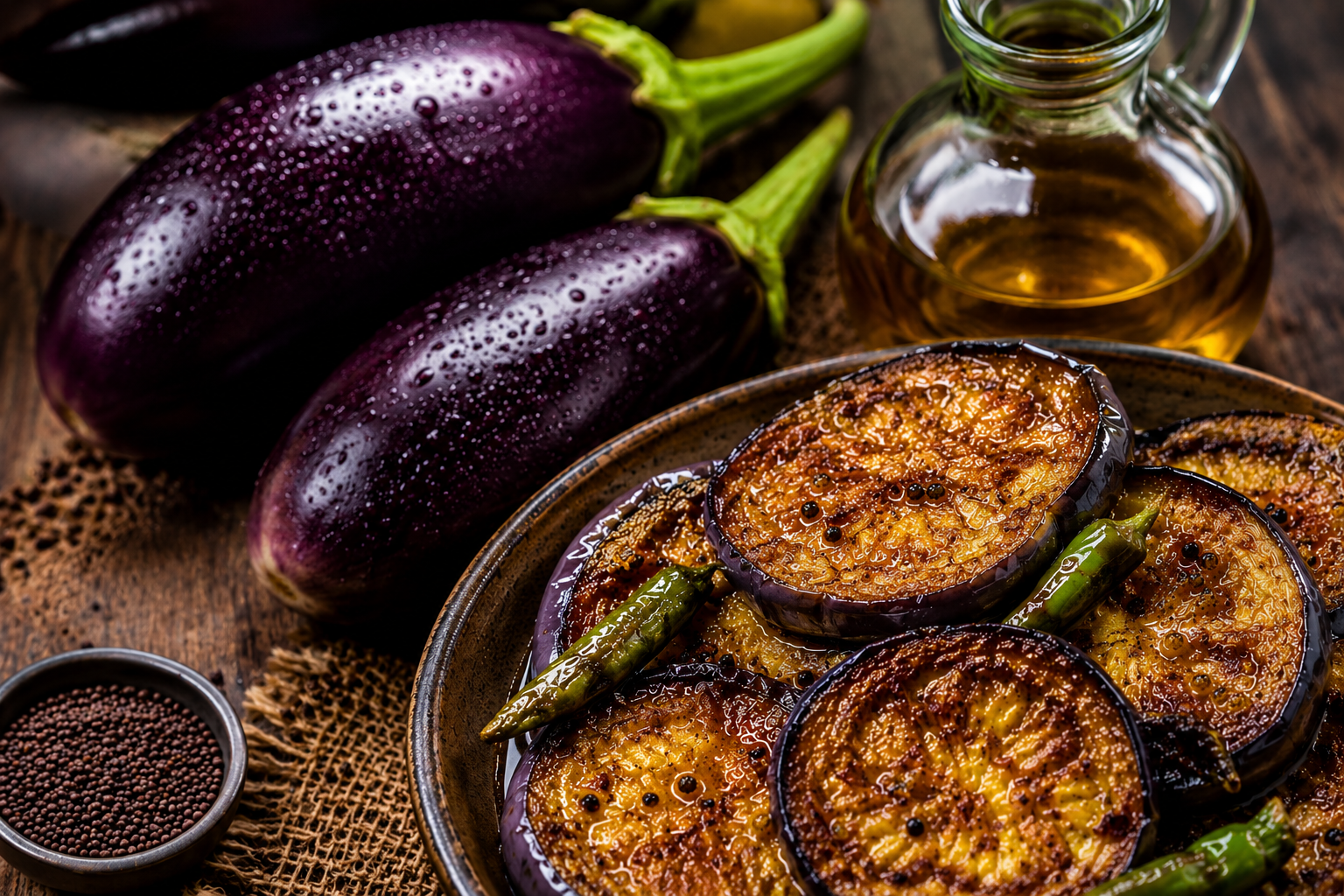
| Fun Culinary Fact: In traditional Bengali kitchens, Begun Bhaja (fried eggplant slices) are scored with shallow knife cuts before frying. This allows the hot mustard oil to instantly penetrate the core, cooking the flesh into a custard-like texture while crisping up the skin. |
The Nutrient Bonus
Apart from tasting phenomenal, this pairing is actually incredibly smart from a nutritional standpoint.
-
Bioavailability: Brinjals are rich in fat-soluble vitamins and antioxidants like nasunin (found in that beautiful purple skin). Cooking them in a healthy fat like mustard oil helps your body absorb these nutrients much more efficiently.
-
The Good Fats: High-quality, cold-pressed mustard oil has an ideal ratio of Omega-3 and Omega-6 fatty acids, making it a heart-healthy choice compared to heavily processed refined oils.
Want to Experience It Tonight?
If you want a quick taste of this synergy without a complex recipe, try this absolute classic:

Chop a brinjal into cubes, toss it with a pinch of turmeric and salt, and shallow fry it in a couple of tablespoons of mustard oil until the edges turn golden-brown and the inside feels like warm butter.
Pair it with simple dal and rice, and you’ll instantly see why this culinary duo has survived for centuries.
If you like this post, a share would be epic!


0 comments on “Brinjal and Mustard Oil: Why This Pairing Just Works”