

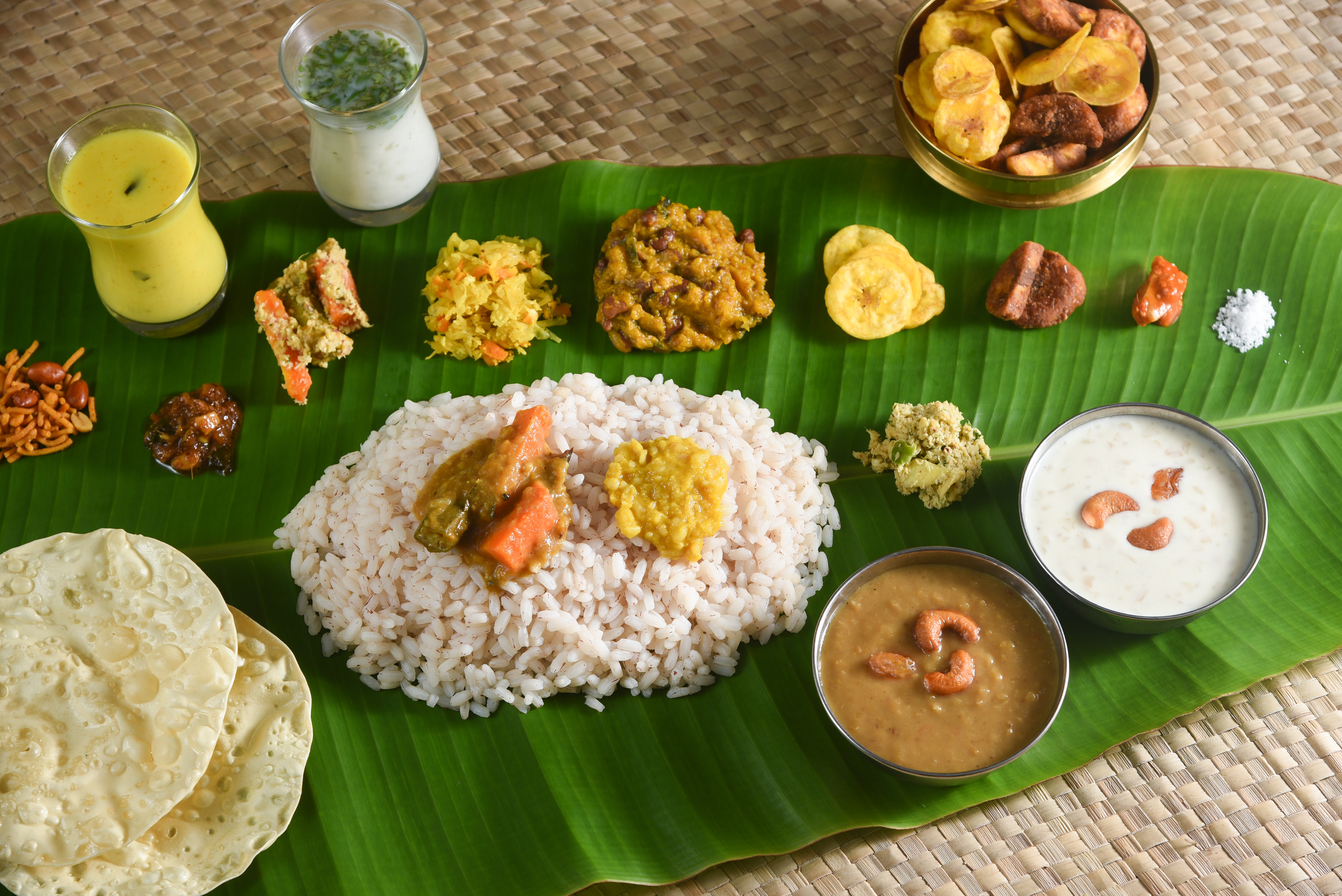
A full Onam Sadya can run to 20-30 dishes on a single banana leaf — beautiful, but not something every kitchen has time for. This mini version keeps the five dishes that carry the most flavour and meaning: a dal, a lentil-vegetable stew, a mixed vegetable curry, a sweet-tangy yoghurt side, and a payasam to finish. Cook these five, and you’ve got the real Sadya experience on your table.
1. Parippu (Split Moong Dal Curry)

Parippu — moong dal cooked soft and finished with a coconut-cumin paste — is the first dish served in any Sadya, eaten mixed with rice and a spoon of ghee before anything else arrives.
Prep time: 10 mins | Cook time: 20 mins | Serves: 4
Ingredients
- Split yellow moong dal — ½ cup
- Turmeric powder — ¼ tsp
- Water — 1½ cups
- Grated coconut — ¼ cup
- Cumin seeds — ½ tsp
- Green chilli — 1
- Coconut oil — 1 tbsp
- Mustard seeds — ¼ tsp
- Shallots, sliced — 4-5
- Dried red chilli — 1
- Curry leaves — 1 sprig
- Salt — to taste
Method
- Dry roast the moong dal in a pan until lightly golden.
- Add water and turmeric powder.
- Pressure cook for 3 whistles, then let the pressure release naturally.
- Grind coconut, cumin seeds, and green chilli into a smooth paste with a little water.
- Mash the cooked dal lightly and stir in the coconut paste.
- Simmer for 3-4 minutes until well combined.
- Heat coconut oil in a small pan.
- Add mustard seeds and let them splutter.
- Add shallots, dried red chilli, and curry leaves.
- Fry until the shallots turn golden.
- Pour the tempering over the dal and stir through.
Tip: Serve with a drizzle of ghee over hot rice — this is the traditional way to start the meal.
2. Sambar (Lentil & Vegetable Stew)

Sambar brings tamarind, toor dal, and a mix of vegetables like drumstick and pumpkin together into a thinner, tangier curry than the dal course — it’s what ties the rice-based part of the meal together.
Prep time: 15 mins | Cook time: 30 mins | Serves: 4
Ingredients
- Toor dal — ½ cup
- Turmeric powder — ¼ tsp
- Drumstick, cut into pieces — 1
- Pumpkin, cubed — ½ cup
- Carrot, cubed — 1
- Brinjal, cubed — 1
- Tomato, chopped — 1
- Tamarind — a small lemon-sized ball, soaked in warm water
- Sambar powder — 1½ tbsp
- Coconut oil — 1 tbsp
- Mustard seeds — ½ tsp
- Dried red chilli — 2
- Curry leaves — 1 sprig
- Salt — to taste
Method
- Pressure cook the toor dal with turmeric powder until soft, then mash lightly.
- In a separate pot, cook the drumstick, pumpkin, and carrot with a little water and salt until nearly tender.
- Add the brinjal and tomato, and cook until softened.
- Squeeze the soaked tamarind to extract the juice, then discard the pulp.
- Add the tamarind juice and sambar powder to the vegetables.
- Simmer for 5 minutes to let the flavours combine.
- Stir in the cooked, mashed dal.
- Simmer for another 5 minutes.
- Heat coconut oil in a small pan.
- Add mustard seeds, dried red chilli, and curry leaves, and let them splutter.
- Pour the tempering over the sambar.
Tip: Add the drumstick early since it takes the longest to cook, but keep an eye on it — overcooked drumstick turns fibrous.
3. Avial (Mixed Vegetables in Coconut-Yogurt Gravy)

Avial is a medley of vegetables — usually raw banana, yam, carrot, beans, and drumstick — cut into even strips and cooked together in a coconut and green chilli paste, finished with yoghurt and a splash of coconut oil at the end.
Prep time: 15 mins | Cook time: 20 mins | Serves: 4
Ingredients
- Raw banana, cut into strips — 1 small
- Yam, cut into strips — ½ cup
- Carrot, cut into strips — 1
- Beans, cut into strips — 10
- Drumstick, cut into strips — 1
- Turmeric powder — ¼ tsp
- Grated coconut — ½ cup
- Cumin seeds — 1 tsp
- Green chilli — 2
- Curd (yoghurt) — 3 tbsp
- Coconut oil — 1 tbsp
- Curry leaves — 1 sprig
- Salt — to taste
Method:
- Cut all the vegetables into similar-sized strips for even cooking.
- Place the vegetables in a thick-bottomed pan with turmeric powder, salt, and just enough water to cover them.
- Cover and cook on medium heat until nearly tender.
- Grind the coconut, cumin seeds, and green chilli into a coarse paste, without adding water.
- Add the coconut paste to the cooked vegetables.
- Mix well and cook for 2-3 minutes until the raw smell of the coconut disappears.
- Whisk the curd until smooth, then stir it into the vegetables.
- Cook for 1-2 minutes more, without letting it boil hard.
- Turn off the heat and drizzle over coconut oil.
- Add curry leaves and mix gently.
Tip: Keep the vegetables slightly firm rather than fully soft — Avial should hold its texture, not turn mushy.
4. Pavakka Mezhukkupuratti (Kerala-Style Bitter Gourd Stir-Fry)

Pavakka Mezhukkupuratti is a classic dry side dish where thinly sliced bitter gourd is slow-roasted in coconut oil with shallots, crushed garlic, and crunchy coconut slices (thenga kothu). The gentle caramelisation and savoury aromatics soften the bitter edge, making it the perfect dry accompaniment to balance out the gravy dishes on your leaf.
Prep time: 10 mins | Cook time: 20 mins | Serves: 4
Ingredients
- Bitter gourd (pavakka), deseeded and cut into thin half-moons — 2 medium
- Shallots (sambhar onions), thinly sliced — 8–10
- Garlic cloves, crushed — 4–5
- Fresh coconut bites (thenga kothu), thinly sliced into slivers — 2 tbsp
- Turmeric powder — ¼ tsp
- Kashmiri red chilli powder — 1 tsp
- Black pepper powder, freshly cracked — ½ tsp
- Coconut oil — 1½ tbsp
- Mustard seeds — ½ tsp
- Curry leaves — 1–2 sprigs
- Salt — to taste
Method
- Toss the sliced bitter gourd with turmeric powder, red chilli powder, and ½ teaspoon of salt. Let it rest for 5–7 minutes so the spices coat evenly.
- Heat coconut oil in a wide, heavy-bottomed pan or uruli. Add mustard seeds and let them splutter.
- Add the coconut slices (thenga kothu) and sauté for a minute until they turn light golden.
- Add the sliced shallots, crushed garlic, and curry leaves. Sauté on medium flame until the shallots soften and turn translucent.
- Add the spiced bitter gourd slices into the pan and mix well with the aromatics.
- Sprinkle 1–2 tablespoons of water, cover with a tight-fitting lid, and cook over medium-low heat for 8–10 minutes, until the slices turn tender.
- Remove the lid, turn the heat to medium-low, and stir in the black pepper powder. Continue to roast uncovered for another 5–7 minutes, stirring occasionally, until the edges turn crisp and lightly caramelised.
- Turn off the heat and serve warm alongside rice, parippu, and ghee.
Tip: Sautéing the coconut pieces until golden first releases sweet nuttiness into the oil, which balances the natural bitterness of the gourd throughout the slow roast.
5. Pachadi (Pineapple in Sweet-Tangy Coconut Yoghurt)

Pachadi is Kerala’s version of a raita — here made with pineapple, so it lands sweet, tangy, and mildly spiced all at once, cutting through the richer dishes on the leaf.
Prep time: 10 mins | Cook time: 15 mins | Serves: 4
Ingredients
- Pineapple, cubed — 1¼ cups
- Green chilli, chopped — 2
- Turmeric powder — ¼ tsp
- Grated coconut — ¼ cup
- Cumin seeds — ½ tsp
- Curd (yoghurt), whisked — ½ cup
- Coconut oil — 1 tbsp
- Mustard seeds — ¼ tsp
- Dried red chilli — 2
- Curry leaves — 1 sprig
- Salt — to taste
Method
- Cook the pineapple with green chilli, turmeric powder, salt, and a little water until soft.
- Grind the coconut and cumin seeds into a smooth paste with a little water.
- Add the coconut paste to the cooked pineapple.
- Mix well and simmer for 2-3 minutes.
- Turn off the heat and let it cool slightly.
- Stir in the whisked curd.
- Heat coconut oil in a small pan.
- Add mustard seeds, dried red chilli, and curry leaves, and let them splutter.
- Pour the tempering over the pachadi.
Tip: Add the curd only after the pan is off the heat — boiling curd can cause it to split.
No Sadya feels complete without something sweet to finish it off. If you’re short on time, skip the stove and reach for a pack of Crisp banana chips glazed in jaggery, ready to go straight onto the leaf.

Lay a banana leaf out lengthwise, and arrange Parippu, Sambar, Avial, Pavakka, and Pachadi with rice in the centre. Add extras like coconut chutney, mango or lime pickle, a crisp papadam, and sambharam around it. Eat with your hands, mixing each curry into the rice as you go. Finish with the Sarkara Upperi once the leaf is nearly clear.
Savour it slowly; a Sadya was never meant to be rushed.
You may also like:
Onam: Celebrating the Rich Heritage and Traditions of Kerala
A beautiful taste of Kerala’s traditional Sadya! 😍🌿