

There is a version of India’s independence story that rarely made the textbooks. It was fought not with rifles, but with rotis. Not in courtrooms, but in kitchens.
Between 1857 and 1947, ordinary meals became extraordinary acts of defiance. Watchmen ran through the dark carrying chapatis no colonial officer could explain. Confectioners sold rebellion boxed as tricolour barfi right under the noses of the Raj. And when a single pinch of salt was outlawed, a nation gathered to break the law together, in plain sight, on the shores of the Arabian Sea.
This Independence Day, look beyond the grand speeches and national parades. Here is what was really brewing in your great-grandparents’ kitchens—and how India cooked, shared, and ate its way to freedom.
1. The Cartridge That Started It All (1857)

It started with a bite. When the British introduced the new Enfield rifle, loading it required soldiers to bite open paper cartridges greased with animal fat.
For Hindu and Muslim sepoys, this was an unpardonable violation of sacred faith. What the Raj treated as simple military logistics became the tipping point of the 1857 Uprising—the first major strike in India’s long march toward independence.
One greased cartridge. One empire, shaken.
2. The Mystery of the Roti Movement (1857)

Just before the revolt broke out, something strange moved through North India. Watchmen carried four plain chapatis into a village under cover of darkness.
They handed them to the local chowkidar with one instruction: bake five more, and pass them on. No note. No ink. No signature.
British officers panicked. They searched the chapatis for hidden messages and found nothing, which somehow made it worse. Historians still debate what it really meant, and it is still an unsolved historical mystery.
Sometimes the scariest message is the one you can’t decode.
3. Sweets That Carried Secrets (Post-1857)

After 1857, forced into hiding, revolutionaries relied on nutrient-dense pinnis and laddus—sweets that could last for weeks without spoiling.
But mithai became much more than food. Freedom fighters hollowed out laddus to smuggle rolled rice-paper notes past British checkpoints. If searched, the courier could simply eat the evidence.
Right under the eyes of the Raj, a simple box of sweets turned into a clandestine communication network.
4. The Great Sugar Boycott (1905)

When Bengal was partitioned in 1905, political protest moved straight to the dining table.
Under the Swadeshi Movement, British salt and refined sugar became targets for public bonfires. Neighbourhoods fined residents who bought imported staples, and priests refused to bless weddings in homes using foreign sugar.
Decades before Gandhi marched to Dandi, Bengal proved that the humblest pantry ingredients could be transformed into weapons of resistance.
5. When Dessert Became Defiance (1920s–1940s)

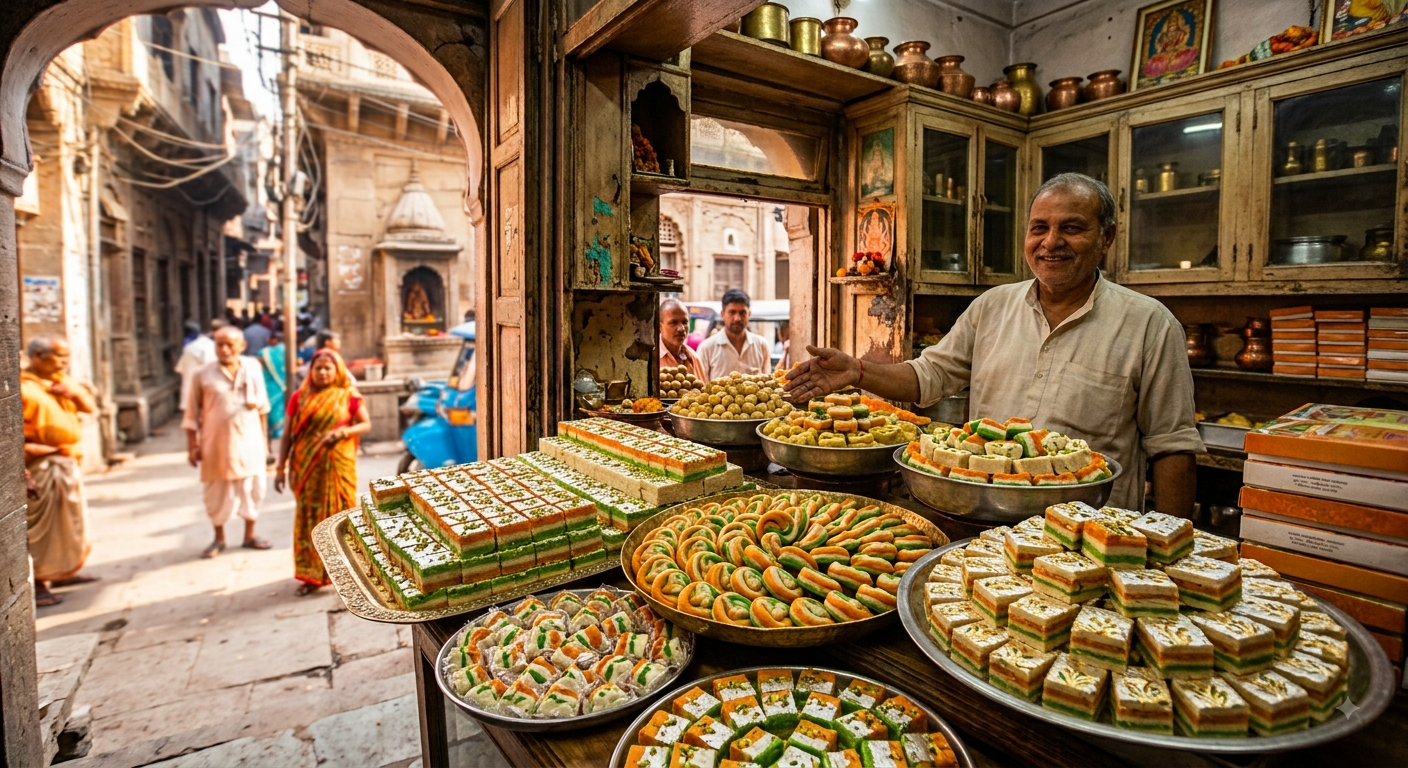
When colonial authorities banned the national flag, sweet makers in Varanasi found an unprosecutable loophole: a three-layered barfi crafted in saffron, white, and green. Eating the tricolour became a public act of quiet defiance.
In Kanpur, sweet maker Ram Avtar Pandey took a lighter approach to resistance. Mahatma Gandhi had urged the nation to boycott mill-processed white sugar in favour of traditional village jaggery, warning that refined sugar supported British industrial interests. Unable to abandon the prized ingredient, Pandey cheekily owned up to his compromise—naming his shop Thaggu Ke Laddoo (“Cheat’s Laddoo”).
You can ban a flag. You cannot arrest a dessert.
6. The Fistful of Salt That Shook an Empire (1930)

Salt. Not gold, not grain—just the most fundamental ingredient in every kitchen.
Under the Salt Act of 1882, the British Empire made it illegal for Indians to collect or produce their own salt. Everyone, rich or poor, was forced to buy heavily taxed colonial supplies.
By turning a basic human necessity into a crime, the Raj handed Gandhi his most powerful symbol. With a single handful harvested at Dandi, a humble kitchen staple ignited a nationwide revolution.
While others ignored the small tax, Gandhi used it to bring the country together.
7. One Plate, Every Caste (Ongoing through the movement)

At the historic 1917 Cherai feast in Kerala, participants challenged untouchability by eating food served by lower-caste children.
The gathering was part of Panthibhojanam, also known as Misra Bhojanam (inter-dining), a reform practice during the Renaissance movement where people from different communities sat together and ate under one roof.
At a time when caste divisions could deepen social fragmentation, such acts of unity also stood against the British divide-and-rule strategy. There were no separate seating lines or privileges based on traditional ritual status.
Unity didn’t need a manifesto. It needed a banana leaf and a shared meal to go around.
8. When Hunger Became the Loudest Protest (1943–1944)

The 1943 Bengal Famine killed millions while the colonial government continued exporting grain out of the province to support wartime reserves.
What followed was one of the rawest chapters of the freedom struggle. Starving villagers and activists walked miles to Calcutta, demanding the very food being shipped away under their own government’s orders.
The tragedy stripped away any remaining illusion of British moral authority, turning food security into a non-negotiable demand for national independence.
Ending hunger became a central demand of the nationalist movement.
Sometimes, the most revolutionary act is simply demanding the right to eat.
9. Mutiny at the Mess Table (1946)

By February 1946, over 1,100 Indian naval ratings aboard the shore establishment HMIS Talwar reached their breaking point. It began in the mess hall over something painfully basic: unpalatable rations and racial abuse from British officers.
What began as a mess-hall complaint rapidly escalated into a full-scale naval mutiny, spreading to over 10,000 sailors across 56 ships and shore establishments.
It was one of the final, decisive cracks in colonial rule—proving that an empire unable to treat its own sailors with dignity could no longer hold on to power.
The Takeaway
None of these stories needed a single bullet fired.
A chapati moved faster than a British informer could report it. A laddoo carried a secret past a checkpoint. A boycotted spoonful of sugar cost the empire real money. A shared plate of khichdi undid centuries of division in a single afternoon.
India didn’t just win its freedom in courtrooms and battlefields. It won pieces of it at the dinner table, one quiet, defiant meal at a time.
This Independence Day, before you sit down to eat, remember: food was never just food. It was always a choice.
Explore our Independence Day collection and shop for your celebrations
You may also like:
Nice compilation of the events in the Freedom Struggle mainly from food perspective hats off to all freedom fighters